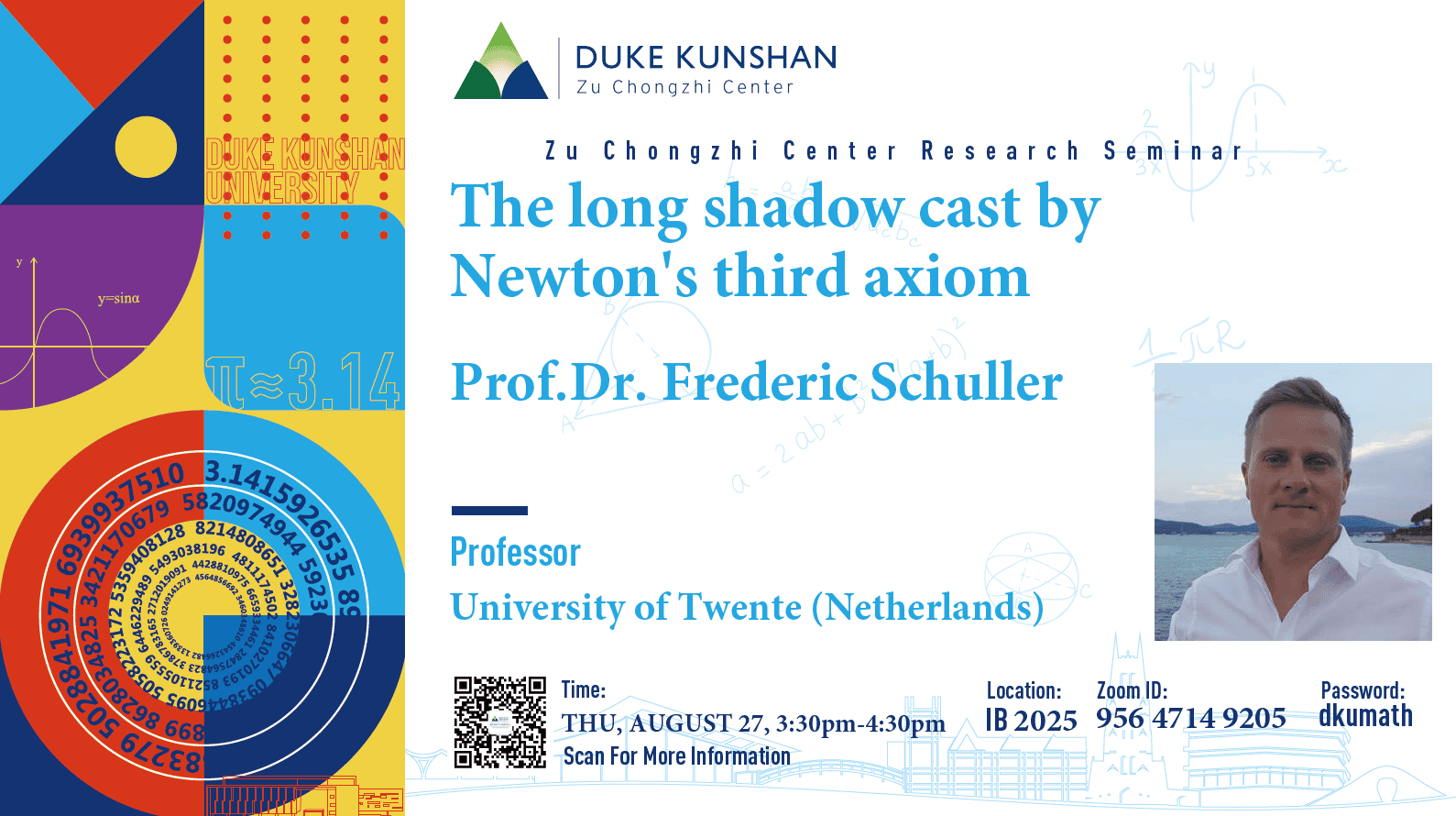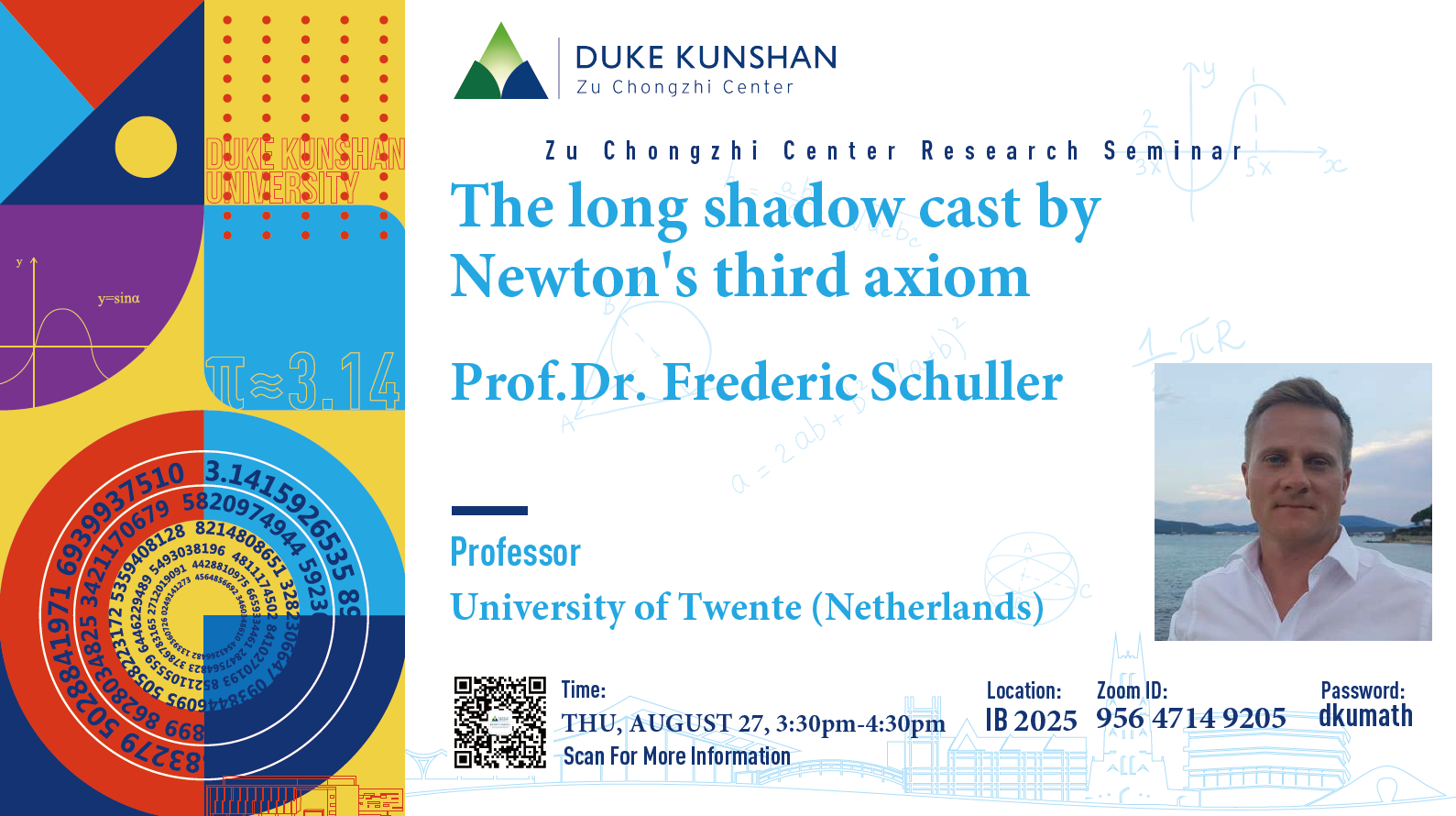
Date and Time (China standard time): Thursday, August 27, 2026 3:30pm-4:30pm
Location: IB 2025
Zoom: 956 4714 9205, Passcode: dkumath
Title: The long shadow cast by Newton’s third axiom
Speaker: Frederic Schuller, University of Twente
Abstract: While Newton’s first and second axioms are deeply woven into the conceptual and formal machinery of modern theoretical physics, his third axiom is frequently treated as a secondary principle with little structural depth beyond its immediate formulation.
In this lecture, we uncover the rich geometric framework — specifically port-Hamiltonian theory — that emerges when all three axioms are fully integrated into modern mechanics. Just as standard Hamiltonian mechanics casts a long shadow across theoretical physics, the formal incorporation of also the third axiom yields a complete, modern formulation of Newtonian systems.
Far from being restricted to classical mechanics, this refined geometric synthesis reaches into open, interconnected systems and promises fresh insight into fundamental questions in general relativity and quantum theory.
Bio: Prof. Dr. Frederic P. Schuller is a Professor of Mathematics at the University of Twente (Netherlands). He received his PhD in Applied Mathematics and Theoretical Physics from the University of Cambridge and has held research and academic positions at institutions including the Perimeter Institute for Theoretical Physics, the Max Planck Institute for Gravitational Physics (Albert Einstein Institute), UNAM, and Friedrich-Alexander University Erlangen-Nürnberg. His research lies at the intersection of mathematics and theoretical physics, focusing on spacetime, gravitation, differential geometry, and quantum theory.
Beyond his research, Dr. Schuller is widely recognized for his contributions to advanced scientific education. In 2016, he received Germany’s National Teaching Prize (Ars Legendi) for excellence in university-level teaching. His lecture series—including Lectures on the Geometric Anatomy of Theoretical Physics—are known for their rigorous geometric approach to fundamental physics.